






 (307) 441-5030
Table of Contents
- Why Most Wellness Equipment Science Claims Fall Apart
- Medical Device vs Wellness Device FDA: What the Classification Means for You
- How to Read Clinical Studies for Health Products
- The Science-Backed Wellness Product Checklist
- How to Verify Digital and App-Based Wellness Technology
- Red Flags in Wellness Equipment Marketing
- What to Do When the Evidence Is Mixed
- Frequently Asked Questions
Last Updated: September 14, 2026
Why Most Wellness Equipment Science Claims Fall Apart
Most wellness equipment science claims fall apart because the companies selling the equipment are not required to prove their products work before putting them on the market. A massage chair, a red light panel, or a home sauna can be advertised with words like "clinically proven" and "detoxifying" without ever running a trial that meets basic research standards. This guide from Logic Health explains how to verify wellness equipment science yourself, using the same primary sources researchers and regulators rely on.
The problem is structural, not a matter of a few bad actors. The Food and Drug Administration regulates medical devices, but most wellness products are marketed as general wellness items and sit outside that framework entirely. That means the burden of proof shifts to you, the buyer. Below, we'll show you exactly how to check a device's regulatory status, read the studies behind a health claim, and spot the marketing language that signals there's no evidence at all. The payoff is simple: you stop paying premium prices for equipment that may be no more effective than a placebo.
Medical Device vs Wellness Device FDA: What the Classification Means for You
The distinction between a medical device and a wellness device comes down to intended use, not technology. Under the FDA's general wellness policy, a product is treated as a wellness device when it makes only general claims about maintaining a healthy lifestyle and presents a low risk of harm (the FDA). If a company claims its device diagnoses, treats, cures, or prevents a specific disease, that product crosses into medical device territory and requires FDA clearance or approval before it can be legally marketed (the FDA).
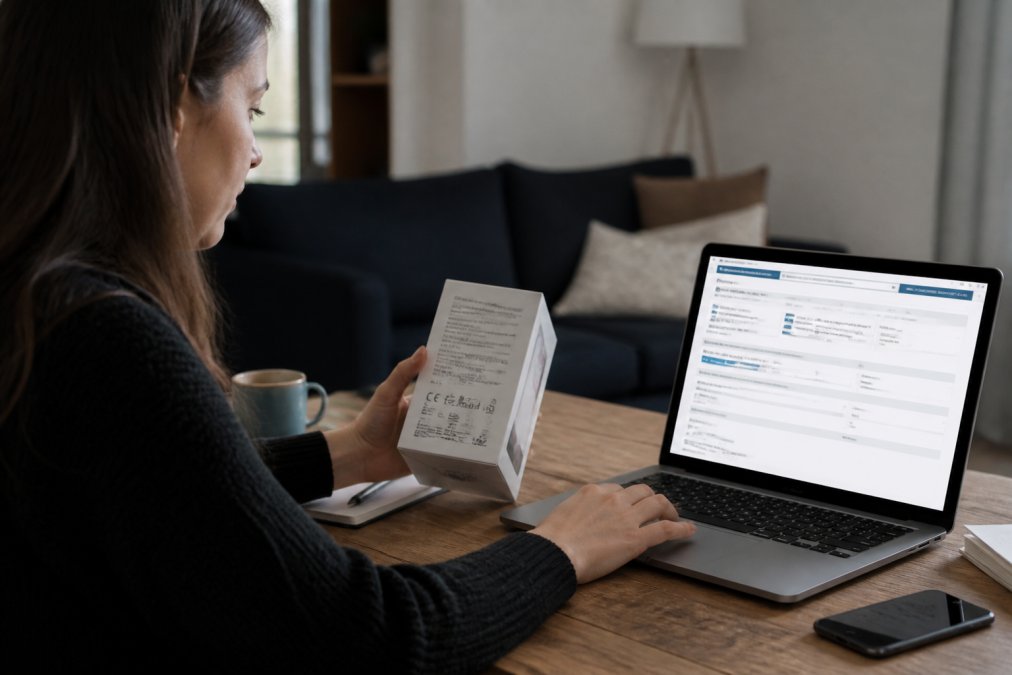
That single distinction changes what you can expect from the science. A cleared medical device has submitted evidence to the FDA demonstrating safety and effectiveness for a defined use. A general wellness device has submitted nothing, because the law does not require it to. This doesn't automatically make wellness equipment ineffective, but it does mean the manufacturer's claims are unverified by any regulator.
How to Look Up a Device in the FDA Databases
Checking a device takes about five minutes if you know which database to search. The FDA maintains separate registries for cleared devices, approved devices, and recalled products, and each one answers a different question.
- Go to the FDA's device databases page and choose the appropriate registry.
- Search by the company name or the product's brand name, not by the marketing term on the box.
- Check the 510(k) database for moderate-risk devices cleared as substantially equivalent to an existing product.
- Check the PMA database for high-risk devices that went through the stricter premarket approval process.
- Check the recall database for any enforcement actions, even if the product is currently cleared.
- Note the clearance number and the date, then confirm the indications for use match what the seller claims.
If a device does not appear in any database, the company is either marketing it as a general wellness product or making claims it cannot legally support. Both answers tell you something useful.
What FDA Clearance Does and Does Not Prove
FDA clearance proves the agency reviewed evidence that a device is safe and effective for its stated indications. It does not prove the device works for every benefit a marketer attaches to it. A device cleared for temporary relief of minor muscle pain is not cleared for improving athletic recovery, boosting circulation systemically, or detoxifying tissue, even if the marketing implies all three.
The FDA publishes guidance on general wellness products that spells out where that line sits. Read it once and you'll spot overreach instantly.
How to Read Clinical Studies for Health Products
Reading a clinical study for a health product means answering three questions before you trust the conclusion: who was studied, how many of them, and whether the result could have happened by chance. A study can be peer-reviewed, published in a legitimate journal, and still tell you almost nothing about whether the product will work for you.
Start with the abstract, then jump straight to the methods section. The methods tell you the truth the abstract tends to soften.
Study Design, Sample Size, and Statistical Significance
The strongest evidence comes from randomized controlled trials, where participants are assigned to the treatment or a placebo group by chance and neither side knows which they received. Weaker designs, like a single-arm study where everyone gets the treatment, cannot rule out the placebo effect. That matters enormously in wellness, because subjective outcomes like pain, fatigue, and relaxation respond strongly to expectation.
Sample size determines how much confidence you can place in a result. A study of 12 participants showing a trend is a pilot, not proof. Statistical significance tells you the result is unlikely to be due to chance, but it says nothing about whether the effect is large enough to matter in daily life. A device can produce a statistically significant improvement that's so small you'd never notice it.
Look for these markers of a credible study:
- Randomized assignment with a control or sham group
- A sample size in the hundreds, not the dozens, for a general claim
- Blinding of participants and assessors where possible
- Outcomes measured with validated instruments, not custom questionnaires
- Results replicated by at least one independent research group
Spotting Industry-Funded Research and Conflict of Interest
Industry funding doesn't automatically invalidate a study, but it changes how much weight you give it. When a manufacturer pays for the research, the manufacturer typically designs the protocol, chooses the outcomes, and controls which results get published. Those choices shape conclusions as much as the data does.
Check the disclosure section at the end of any paper. You're looking for who funded the work, whether the authors are employees of the company, and whether they hold patents or equity in the product. A study funded by the maker and authored entirely by its staff is marketing with a DOI, not independent verification.
The strongest evidence base for a product includes at least one trial run by researchers with no financial relationship to the manufacturer. If every study you find traces back to the same company, treat the claim as unproven.
The Science-Backed Wellness Product Checklist
A science-backed wellness product meets five tests: a clear intended use, verifiable regulatory status, independent peer-reviewed evidence, transparent labeling, and a manufacturer willing to disclose funding and testing. Products that fail two or more of these tests are being sold on marketing, not evidence.
Use this checklist before you buy:
- The product states a specific intended use rather than a vague wellness promise
- The manufacturer name and model number appear in an FDA database, or the product is honestly labeled as a general wellness item
- At least one peer-reviewed study on the exact device or a close equivalent exists
- The study was conducted independently of the manufacturer, or the conflict is disclosed
- The label lists materials, power output, and any relevant specifications
- The company publishes its testing methodology or third-party certification
- The seller makes no disease-treatment claims unless the device is cleared for them
Run this list against any major purchase. Most equipment that survives all seven items is worth the money, and most that fails is a gamble.
How to Verify Digital and App-Based Wellness Technology
Digital and app-based wellness tools are the hardest category to verify, because there's often no physical device to look up in a regulatory database. A meditation app, a recovery-tracking algorithm, or a biometric-monitoring platform can claim scientific backing without ever appearing in a device registry.

Treat the software as a medical device question. If an app claims to diagnose a condition, monitor a vital sign for clinical decisions, or deliver a therapeutic treatment, the FDA generally considers it software as a medical device and expects it to go through the same review pathway as hardware. An app that only tracks general wellness metrics, like step count or sleep duration, usually falls outside that scope.
For apps, verification means reading the privacy policy and the data-handling practices as carefully as the science page. Ask where the biometric data goes, whether it's sold or shared, and whether the company publishes its validation studies. A recovery app that scores your readiness without disclosing its algorithm or validation data is asking for trust it hasn't earned.
Red Flags in Wellness Equipment Marketing
Certain phrases are reliable signals that a product's science is thin. "Detoxifies," "balances your energy," "boosts your immune system," and "clinically proven" without a citation all appear on the FDA's radar for a reason: they're either unmeasurable or unsubstantiated.
Watch for these patterns:
- Testimonials standing in for data. A hundred glowing reviews are not evidence of effectiveness, because people who feel better are far more likely to post than people who don't.
- Before-and-after photos with no controls. Lighting, posture, and hydration change how a body looks in a photo within hours.
- Borrowed science. The page cites studies on a related mechanism, like heat therapy in general, rather than on the specific device being sold.
- Vague authority. "Doctor-recommended" or "used by professional athletes" without naming who, where, or under what protocol.
- Urgency and scarcity. Countdown timers and "only 3 left" pressure you past the verification step, which is exactly the point.
None of these prove a product is worthless. Together, they tell you the seller is relying on persuasion rather than evidence, and that's information you can act on.
What to Do When the Evidence Is Mixed
Mixed evidence is the normal state of affairs for most wellness equipment, and it doesn't mean you should walk away. It means you should match the strength of the evidence to the size of the purchase and the specificity of the claim.
A device with strong evidence for general relaxation and weak evidence for athletic recovery is a reasonable buy if relaxation is what you want. It's a poor buy if you're paying a premium for recovery benefits that the research doesn't support.
Ask three questions when the science is unclear. What is the most conservative benefit the evidence actually supports? How much of the price is attached to the unsupported claim? And is there a cheaper product that delivers the supported benefit just as well?
| Evidence Strength | What It Means | How to Proceed |
|---|---|---|
| Multiple independent RCTs | Strong, replicated support | Buy with confidence for the studied use |
| One small independent trial | Promising but unconfirmed | Buy if the price reflects uncertainty |
| Manufacturer-funded studies only | Unverified, potential bias | Treat claims as marketing, not proof |
| Mechanism studies, no human trials | Theory without outcomes | Wait for human data before paying a premium |
| No studies at all | Unsupported | Only buy for comfort or enjoyment, not health claims |
For buyers who want equipment that has already been through this filter, Logic Health curates products with documented specifications and transparent sourcing, so you start from a verified baseline rather than a marketing page.
Verifying wellness equipment science takes an afternoon of homework, but it's the difference between buying a tool that supports your health and buying a story. Logic Health exists to make that easier: every product in our catalog comes with clear specifications, and our 24/7 customer support team is available to answer questions about sourcing and intended use before you commit. With free shipping on orders over $200, a 30-day return policy, and no tax, you can test a product against your own body and send it back if it doesn't deliver. Shop now at Logic Health and build your recovery setup on evidence rather than promises.
Frequently Asked Questions
What is the difference between a medical device and a wellness device?
The FDA regulates medical devices, which must go through clearance or approval processes and carry intended-use claims for diagnosing, treating, or preventing disease. Wellness devices make general health or lifestyle claims and fall outside that regulatory pathway. A massage chair marketed for relaxation is a wellness device; one marketed to treat chronic pain may cross into medical device territory. Knowing which category a product falls into tells you how much independent scrutiny its claims have received.
How can I tell if a wellness product's health claims are scientifically valid?
Look for peer-reviewed studies published in independent journals, not manufacturer white papers. Check whether the study used a control group, measured outcomes with validated instruments, and reported statistical significance. Search PubMed for the product's core mechanism or brand name. If the only evidence is a company-funded study with no placebo control, treat the claim as unproven. A science-backed wellness product checklist should include at least one independent, peer-reviewed study supporting the specific claim.
Are 'science-backed' labels on wellness products regulated by the FDA?
No. The phrase 'science-backed' is a marketing term with no legal definition or regulatory oversight. Any manufacturer can print it on packaging regardless of the evidence behind the product. The FDA regulates specific claims about treating or preventing disease, but general wellness language falls outside its enforcement scope. This is why independent verification matters: you cannot rely on a label to confirm that a product's claims have been tested or validated.
What red flags should I look for when buying wellness equipment?
Watch for claims that promise rapid, dramatic results without citing specific studies; testimonials used in place of clinical evidence; vague references to 'clinical trials' with no journal name or author; and pressure tactics like limited-time pricing. Also check whether the manufacturer discloses funding sources for any cited research. If a company cannot or will not share peer-reviewed data supporting its claims, that silence is itself a signal. Third-party certification from recognized testing bodies adds another layer of trust.