






 (307) 441-5030
Table of Contents
- Step 1: Read the Label Before the Sales Page
- Step 2: Know How FDA Health Claim Regulations Work
- Step 3: Spot the Red Flags in Wellness Marketing
- Step 4: Evaluating Clinical Study Quality Like a Researcher
- Step 5: Check Third-Party Testing and Certifications
- Step 6: Use Digital Tools to Verify Wellness Claims in Real Time
- Step 7: Match the Evidence to Your Actual Goal
- Frequently Asked Questions
Last Updated: September 19, 2026
Step 1: Read the Label Before the Sales Page
Knowing how to verify wellness product claims starts with one habit: read the label before you read the sales pitch. The label is regulated. The sales page is not.
What the Nutrition Facts Panel and Supplement Facts Tell You
The panel answers three questions fast:
- What is actually in the product?
- How much of each ingredient per serving?
- What is the serving size, and does it match what you'd take?
If the dose is tiny compared to what studies use, the product likely won't do much.
Decoding the FDA Disclaimer on Structure/Function Claims
A structure/function claim describes how a nutrient affects normal body function. "Calcium builds strong bones" is one example. These claims do not need FDA review before sale.
Step 2: Know How FDA Health Claim Regulations Work
FDA health claim regulations split claims into three tiers, and each tier carries a different level of proof.
Step 3: Spot the Red Flags in Wellness Marketing
Red flags in wellness marketing usually show up before you read a single ingredient. They live in the language and the design.
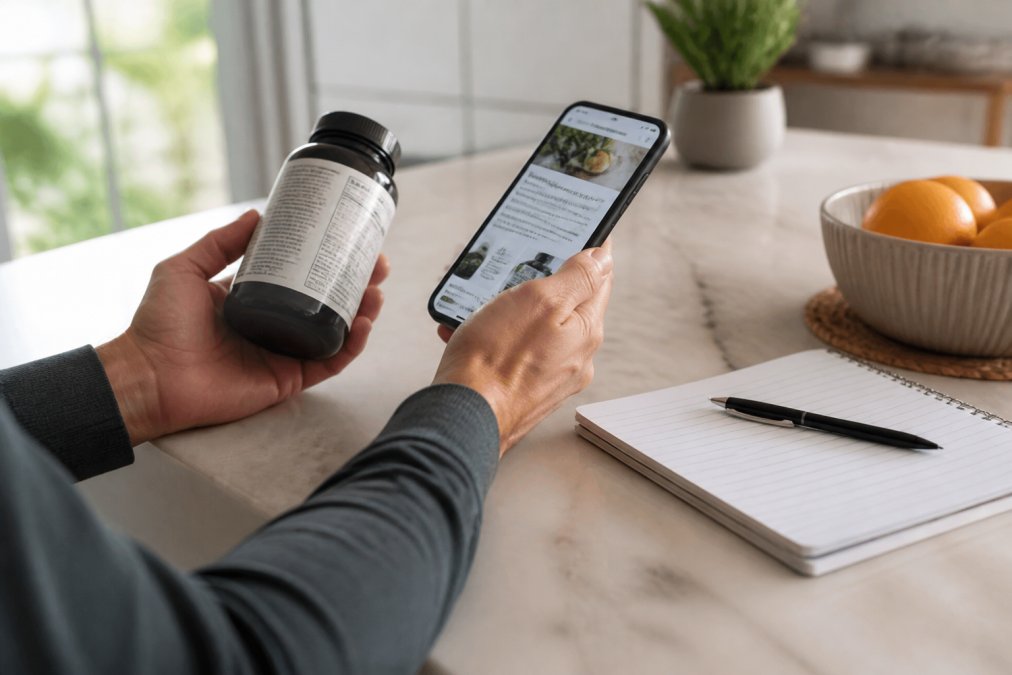
Watch for these:
- Miracle language: "cures," "melts fat," "reverses aging"
- One-ingredient fixes: real health rarely works that way
- Fake urgency: countdown timers and "only 3 left"
- Borrowed authority: "doctor-formulated" with no name attached
- Before-and-after photos with no timeline or context
Visual Clues in Deceptive Packaging
Deceptive packaging does quiet work. Look for:
- Tiny asterisks linking to vague footnotes
- "Clinically studied" ingredients, not a clinically studied product
- Certifications that look official but aren't verifiable
- Serving sizes split so the label looks stronger
Snap a photo of the front and back. Compare the promises to the panel. The gap tells you plenty.
Step 4: Evaluating Clinical Study Quality Like a Researcher
Evaluating clinical study quality means asking who was studied, how many, and whether the study was controlled.
Rank evidence in this order:
- Randomized controlled trials in humans
- Observational studies in humans
- Animal studies
- Lab or cell studies
- Anecdotes and testimonials
Clinical Trials vs. Anecdotes and Testimonials
A clinical trial follows a set protocol, measures outcomes, and can be repeated. An anecdote is one person's experience, with no control group and no way to rule out other causes.
Step 5: Check Third-Party Testing and Certifications
Third-party testing confirms what's actually in the bottle, independent of the maker's own lab. The maker's in-house lab has an incentive to pass its own product. An outside lab does not.
Which Seals Actually Mean Something
Not every seal is equal. The ones worth recognizing fall into two groups: certification programs that audit the finished product, and testing labs that issue a report on a specific batch.
Programs commonly cited by practitioners and regulators include:
- USP Verified Mark, run by the United States Pharmacopeia. Covers identity, strength, purity, and dissolution, plus a manufacturing facility audit. The mark is product-specific, not brand-wide.
- NSF Certified for Sport, run by NSF International. Screens for more than 280 substances banned by major athletic organizations, in addition to standard contaminant testing. This is the seal most often referenced when athletes need a clean product.
- ConsumerLab.com, a subscription testing service that buys products off the shelf and publishes pass/fail results. It does not certify; it reports.
- Informed Choice / Informed Sport, batch-level testing for banned substances, with a published list of tested batches.
How to Verify a Certificate of Analysis
A certificate of analysis (COA) is the lab report for a specific batch. If a brand publishes one, check four things:
- Batch number match. The COA batch number must match the number printed on your bottle. A COA for a different batch tells you nothing about your product.
- Named lab. The testing lab should be identifiable and searchable. "Independent lab" with no name is not verifiable.
- Scope of testing. Does the COA cover potency (does the ingredient match the label amount?), identity (is it the right plant or compound?), and contaminants (heavy metals, microbes, residual solvents)? A purity-only COA does not confirm dose.
- Date. A COA from three years ago does not describe the batch you bought last month.
What Third-Party Testing Does Not Cover
Testing confirms identity, potency, and purity. It does not confirm that the product works for the outcome on the front of the bottle. A product can pass every contaminant screen and still have no human trial supporting its main claim. Testing and efficacy are separate questions, you need both.
Step 6: Use Digital Tools to Verify Wellness Claims in Real Time
Most guides stop at "check PubMed." That is not a method, it is a website. Here is the actual workflow, database by database, with the search moves that separate a real check from a glance.
PubMed: Find the Study, Then Read the Right Part
Go to pubmed.ncbi.nlm.nih.gov and search the ingredient name plus the outcome you care about, for example, "ashwagandha sleep randomized controlled trial."
Three filters do most of the work:
- Article type → Randomized Controlled Trial. This removes animal and cell studies in one click.
- Species → Humans. Filters out rodent work that marketers often cite.
- Publication date → last 10 years. Older studies may use doses or formulations that no longer match what is sold.
ClinicalTrials.gov: Check Whether the Trial Was Ever Completed
ClinicalTrials.gov is the federal registry of human trials. It is useful for a different reason than PubMed: it shows trials that were registered and then never reported results.
- Completed, the trial finished. Look for a results section.
- Terminated or Withdrawn, the trial stopped early. The reason is often listed, and it is often worth reading.
- Recruiting or Not yet recruiting, no results exist yet. A brand citing this trial is citing a plan, not evidence.
FDA and FTC Databases: Check the Enforcement Record
The FDA publishes warning letters at fda.gov. Search the brand name. A warning letter for unapproved disease claims is a strong signal that the marketing has already crossed a legal line.
AI Tools: Use Them to Navigate, Not to Conclude
Use them to:
- Translate a dense abstract into plain language. Paste the abstract and ask what the study measured and what it found.
- Generate search terms. Ask for the scientific name of an ingredient and common synonyms, then run those in PubMed.
Do not use them to:
- Confirm whether a claim is true. AI models summarize text; they do not verify it. A confident summary of a bad study is still a bad study.
The NIH Office of Dietary Supplements fact sheets give plain-language summaries of what the evidence says for common ingredients, and they are written by people with no product to sell. Start there when you do not know the ingredient's scientific name.
Step 7: Match the Evidence to Your Actual Goal
Strong evidence for one outcome says nothing about another. A product may support sleep and do nothing for recovery.
Ask three questions:
- What outcome do I actually want?
- Does the evidence measure that exact outcome?
- Is the studied dose the dose in this product?
If any answer is no, keep looking.
Frequently Asked Questions
How do you know if a health claim is approved by the FDA?
The FDA permits only a few authorized health claims, such as the link between calcium and osteoporosis, and these must use specific approved wording. Most supplement statements are structure/function claims, which describe how a nutrient affects normal body function but do not require FDA pre-approval. If a label says a product treats, prevents, or cures a disease, that is a drug claim and the FDA has not approved it for that use. Look for the standard disclaimer: 'This statement has not been evaluated by the FDA.'
What are the biggest red flags in wellness marketing to watch for?
Common red flags include promises of rapid or permanent results, claims that a single product cures multiple unrelated conditions, testimonials used instead of clinical evidence, and pressure tactics like limited-time pricing. Also watch for vague phrases such as 'clinically proven' without a cited study, 'detoxifies' without naming what is removed, and any suggestion that the product replaces medical treatment. Legitimate companies publish ingredient doses, cite peer-reviewed research, and include an FDA disclaimer on structure/function claims.
What should I look for on a product label to ensure it is legitimate?
Start with the Supplement Facts or Nutrition Facts panel to confirm ingredient names and amounts per serving. Check for a manufacturer name and address, a lot number, and an expiration date. Look for third-party testing seals such as USP, NSF, or Informed Choice. Read the FDA disclaimer if structure/function claims appear. A label that hides ingredient amounts behind a 'proprietary blend' or lists no manufacturer contact information is a warning sign worth investigating before you buy.
How can I distinguish between clinical evidence and marketing hype?
Clinical evidence comes from peer-reviewed studies with defined populations, doses, durations, and measurable outcomes. Marketing hype borrows scientific-sounding words without citing a specific study you can read. Search the study title or author on PubMed or Google Scholar. Check whether the study used the same dose and form as the product you are considering. A single small study is weaker than a systematic review or a randomized controlled trial. If the company cannot point to a published study that matches its product, treat the claim as unproven.
Wellness marketing will always outrun regulation, so the checking has to be yours. Logic Health makes that easier with transparent product listings, free shipping on orders over $200, a 30-day return policy, and 24/7 customer support. Get started with Logic Health and choose equipment you can actually evaluate.