






 (307) 441-5030
Table of Contents
- Start With Your Body, Not the Feature List
- Massage Chair Size and Fit: Measure Before You Buy
- Roller Systems, Track Types, and Massage Techniques
- 3D vs. 4D Massage Chair: What the Extra Dimension Buys You
- Massage Chair Price: What Each Tier Actually Delivers
- Comfort Details: Padding, Upholstery, Recline, and Airbag Compression
- The Best Massage Chair for Home Use: Matching the Chair to Your Household
- Safety, Total Cost of Ownership, and Long-Term Maintenance
- Frequently Asked Questions
Last Updated: October 18, 2026
Start With Your Body, Not the Feature List
Most buyers start with rollers, tracks, and airbags.
The Logic Health team regularly meets buyers who picked on features alone and found the roller width missed their shoulders or the seat sat too high for their legs.
The uncomfortable truth most guides skip: the best massage chair for home use is the one that physically fits the people who will sit in it.
Height, Weight, and Body Shape Matching
Height range and weight capacity eliminate options fastest. Most full-size chairs accommodate roughly 5'0" to 6'5" and support several hundred pounds, but check the exact spec. At the edge of a range, rollers may miss your neck or stop short of your lower back. Broader shoulders need wider roller travel; longer legs need a longer track.
Body Scanning and Customization
Body scanning maps your spine and posture before a session, so rollers follow your actual contours instead of a generic path. The Helios Massage Chair from Logic Health uses smart body scan technology to map each user's shape and adjust the session. For households with two very different body types, prioritize a scan-based chair over a fixed-program model.

Massage Chair Size and Fit: Measure Before You Buy
Room fit is where online buyers get burned most. A massage chair is large furniture that also reclines, so its extended footprint exceeds its resting dimensions.
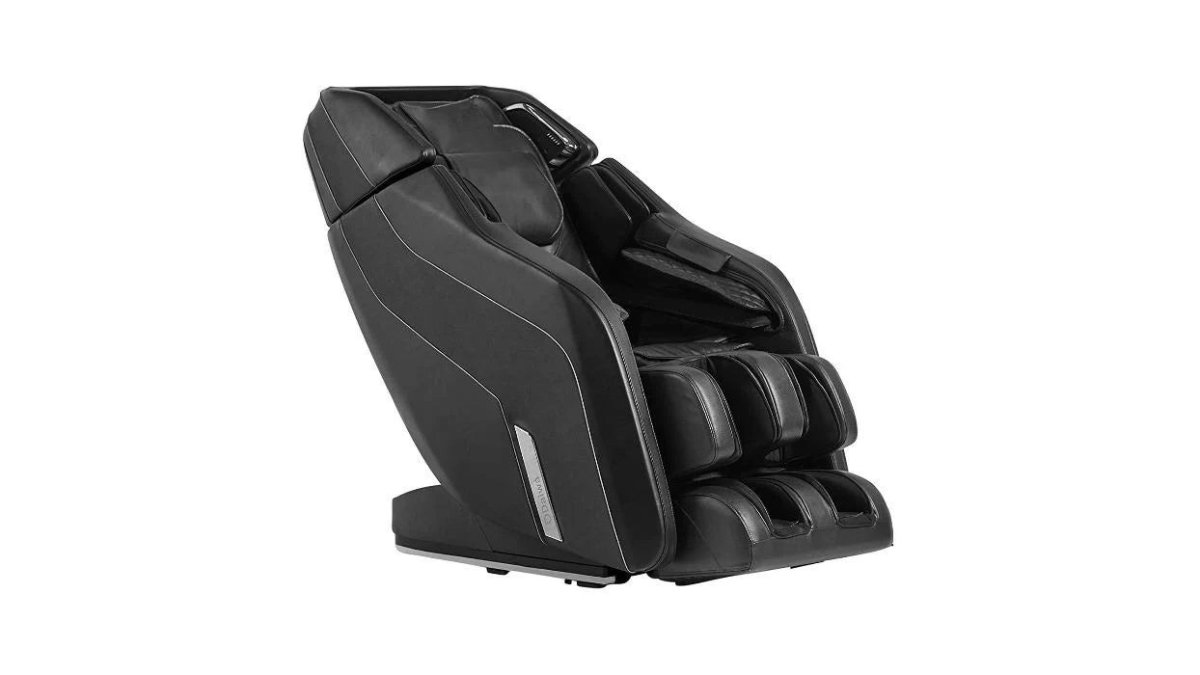
A wall-hugging design solves this for tight rooms. The Daiwa Pegasus 2 Smart Massage Chair uses a pivot-based system that lets it sit nearly flush against a wall while still reaching a full recline, which is a genuine advantage in apartments and small living rooms.

Chair Dimensions, Wall Clearance, and Room Fit
Note three numbers before you shop: upright dimensions, reclined depth, and the manufacturer's minimum wall clearance. Add walking space on at least one side. If reclined depth exceeds your floor space, the chair crowds the room every session. In a compact space, prioritize a wall-hugging model over a larger chair with features you will rarely touch.
Roller Systems, Track Types, and Massage Techniques
The roller system is the heart of any chair, and the track is the rail the rollers travel along. Two types dominate, S-track and L-track, and the difference decides which body parts actually get massaged.
S-Track vs. L-Track and What Each Covers
An S-track follows the spine's S-curve from neck to lower back, keeping rollers in contact with spinal muscles. Some chairs, including the Bodyfriend Phantom Medical Care Massage Chair, combine both in an S&L system for continuous neck-to-thigh coverage.
| Track Type | Coverage | Best For |
|---|---|---|
| S-track | Neck to lower back | Focused spinal and shoulder work |
| L-track | Neck through glutes and thighs | Full-body and lower-body relief |
| S&L combined | Neck to thighs, continuous | Buyers who want complete coverage |
Track length only matters as body coverage. A longer L-track reaches farther under the seat for glute or hamstring tension; a shorter S-track can still excel at upper-back work.
Roller Count, Roller Width, and Speed
Three roller specs decide how a chair feels. Roller count (often two, four, or eight) affects surface area worked at once; four-roller heads cover more muscle per pass. Roller width determines whether the massage reaches your shoulder blades or stops at the spine. Speed range matters more than top speed: a chair that slows to a gentle knead and still delivers a firm tap gives more usable settings.
Also check whether the chair offers a stretch function. Some models use the leg rest and airbags to pull the lower body into a lengthening position while the rollers work the back, which is a different sensation from passive rolling and is worth testing if you sit at a desk all day.
Massage Techniques and Intensity Settings
Techniques matter as much as the track. Kneading works tissue like hands pressing and rolling; tapping uses rapid percussion to wake circulation; rolling glides along the muscle; shiatsu applies focused pressure to specific points.
To compare chairs, ignore technique names and ask three questions: Can the rollers go gentle enough for a sore day? Firm enough for a tight day?
3D vs. 4D Massage Chair: What the Extra Dimension Buys You
The 3D vs. 4D massage chair question comes down to roller depth. A 3D chair's rollers move up and down, side to side, and in and out, so you can adjust depth.
Is 4D worth it? The Bodyfriend PHANTOM II Massage Chair uses 4D technology with adjustable intensity, while the Daiwa Relax 3D Massage Chair pairs 3D body scanning with therapeutic heat and an inversion stretch function.

Massage Chair Price: What Each Tier Actually Delivers
Massage chair price tracks track length, roller sophistication, and build quality. Entry-level chairs offer fixed programs and shorter tracks. Mid-range adds body scanning, zero gravity, and airbag compression. Premium adds 4D rollers, heat, voice control, and full S&L coverage.
At Logic Health, our chairs sit in the premium tier, and the prices reflect what you get: the Daiwa Relax 3D Massage Chair at $8,999, the Bodyfriend PHANTOM II at $8,199, the Helios Massage Chair 8000 and Bodyfriend Phantom Medical Care at $9,999 each, and the Daiwa Pegasus 2 Smart at $10,999.
Comfort Details: Padding, Upholstery, Recline, and Airbag Compression
Comfort is the spec sheet's quietest column and the one you notice daily. Padding density decides whether a long session feels supportive or punishing; upholstery affects breathability and aging; recline range determines how much you can unload your spine.
Zero gravity reclining tilts you back so your knees sit above your heart, reducing spinal pressure. Airbag compression adds a second layer of massage: airbags inflate and deflate around the arms, calves, and feet to squeeze and release.
The Best Massage Chair for Home Use: Matching the Chair to Your Household
The best massage chair for home use fits everyone who will sit in it, not just the person paying. One-person households can optimize for one body.
Accessibility matters too. Check whether buttons are legible, the remote is intuitive, and someone with limited mobility can get in and out safely. Voice control, like on the Daiwa Pegasus 2 Smart, removes friction for users who struggle with small buttons.
How to Test a Chair Systematically
If you can sit in a chair before buying, test it the same way every time. Use this checklist:
- Set the chair to your height and run a body scan
- Test the deepest intensity setting and the gentlest one
- Check neck and shoulder coverage with the rollers at full travel
If you cannot test in person, ask the seller about return terms and read the spec sheet against your measurements. Logic Health offers a 30-day return policy, which gives you a real window to judge fit at home.
Safety, Total Cost of Ownership, and Long-Term Maintenance
Two angles most buying guides skip: safe use and post-purchase cost. This is where a buying decision becomes an ownership decision.
Health Considerations and Safe Use
Massage chairs are generally low-risk but not right for everyone. If you are pregnant, have a pacemaker or implanted device, a recent injury, a blood clot risk, osteoporosis, nerve damage, take blood thinners, or have a condition your doctor flagged, check with a healthcare provider first.
Safe use is also about session habits. The FDA guidance on medical devices is a useful starting point for understanding which health claims are regulated and which are marketing language.
Total Cost of Ownership
Total cost of ownership goes beyond the sticker price. Build a simple worksheet before you buy:
- Delivery and placement: Is curbside delivery included, or is inside placement and assembly an extra fee? A chair that arrives at the curb is not fully delivered.
- Assembly: Some chairs ship mostly assembled; others require attaching the leg rest, arms, and air hoses. Ask who does this and whether it is covered.
- Return and restocking fees: A 30-day return window is only useful if you know the restocking fee and who pays return freight. Confirm both in writing.
Warranty, Durability, and Long-Term Maintenance
A longer warranty on the roller system and frame beats a lower price with a short one. Separate coverage into frame, roller mechanism, electronics, and labor, because a headline "5-year warranty" often means five years on the frame and one on labor.
Durability follows use: a chair used daily by two people wears faster than one used twice a week, so match warranty length to household usage. Keep it on a level floor, leave the specified clearance, and avoid blocking the air intake.
The U.S. Consumer Product Safety Commission maintains recall information worth checking for any large appliance purchase. And for general guidance on buying durable goods, the Federal Trade Commission's consumer advice covers warranties and return rights.
Frequently Asked Questions
Which is better, a 3D or 4D massage chair?
A 3D massage chair moves its rollers in and out, so you can set depth and pressure. A 4D massage chair adds speed control to that depth, changing rhythm within a single pass to mimic a therapist's hands. If you mainly want relaxation and general tension relief, 3D covers it well. If you want adjustable intensity for recovery work on specific areas, 4D gives you finer control. The Bodyfriend Phantom II and Phantom Medical Care both use 4D technology, while the Daiwa Relax 3D uses a 3D body scanning system.
How much should I pay for a good massage chair?
At the premium end, expect to spend roughly $8,000 to $11,000 for a full-feature chair. In Logic Health's lineup, the Bodyfriend Phantom II is $8,199, the Daiwa Relax 3D is $8,999, and the Helios 8000 and Bodyfriend Phantom Medical Care are $9,999 each. The Daiwa Pegasus 2 Smart sits at $10,999. Above entry level, your money goes toward body scanning, 4D rollers, zero gravity recline, and airbag coverage rather than basic vibration.
How do I know if a massage chair will fit my body?
Check the chair's stated height range and weight capacity against your own measurements first. Then look for body scan technology, which maps your shape and adjusts roller position automatically. The Helios 8000 uses smart body scan, and the Daiwa Relax 3D uses a 3D body scanning system that maps height, size, and weight. If you are near the top or bottom of a chair's height range, sit in it before buying if possible.
How much space do I need for a massage chair?
Reclining chairs need clearance behind them, so measure the room, not just the chair. A wall-hugging design like the Daiwa Pegasus 2 Smart uses a pivot system to sit nearly flush against a wall while still reaching full recline, which suits smaller rooms. Standard chairs need several feet of clearance behind the backrest. Measure your doorway and turning space too, since delivery is the moment most people discover a chair will not fit.
Is a zero-gravity massage chair worth it?
Zero gravity reclines the seat and back so your knees sit at or above heart level, which takes pressure off the spine and makes deeper massage easier to tolerate. Most buyers notice the difference in the lower back and legs. It is standard on the Helios 8000, Daiwa Pegasus 2 Smart, Daiwa Relax 3D, and both Bodyfriend Phantom models, so at this price level you should expect it rather than pay extra for it.
What features should I look for when buying a massage chair?
Prioritize fit and mechanism over feature count. Look for a height range and weight capacity that match your household, body scan or 3D scanning, an S-track or L-track roller system, adjustable intensity, and airbag coverage for the shoulders, hips, and calves. Add zero gravity recline, foot rollers, and heat if you want them. The Helios 8000 combines body scan, zero gravity, foot reflexology rollers, and full-body air compression at $9,999.
Can a massage chair help with lower back pain from desk work?
A massage chair can ease muscle tension and help you relax, but it is not a treatment for a medical condition. If you have chronic lower back pain, talk to your doctor before using one, and skip it if you have a condition your doctor advises against. Features that tend to matter most for desk-related tightness are lumbar coverage, adjustable roller depth, heat, and a recline position that unloads the spine.