






 (307) 441-5030
Table of Contents
- Start With a Spatial Framework: Home Gym Layout Ideas
- Choosing Home Gym Equipment That Supports Recovery
- Designing a Dedicated Home Gym Recovery Room
- Flooring, Lighting, Ventilation, and Climate Control
- Setting a Realistic Home Gym Budget
- Safety, Accessibility, and Contraindications
- Frequently Asked Questions
Last Updated: October 17, 2026
Start With a Spatial Framework: Home Gym Layout Ideas
Most home gyms fail at the planning stage, not the equipment stage.
A spatial framework is a written plan that assigns every square foot of your gym a purpose before equipment arrives. It covers zones, traffic paths, power drops, and storage.
Start by listing user goals and available space. Who trains here, how often, and what do they actually do? Then sketch the room to scale.
Zoning Strength, Cardio, Mobility, and Recovery
Split the floor into four zones: strength, cardio, mobility, and recovery. Strength needs the most headroom and floor loading. Cardio needs ventilation and clearance behind treadmills or rowers. Mobility needs open floor and mirrors. Recovery needs quiet, warmth, and proximity to water.
Keep recovery away from the heaviest noise. A massage chair session is useless next to a dropping barbell.

Room Flow, Equipment Placement, and Storage Solutions
Equipment placement should follow a single rule: heavy, fixed items go against walls; movable items go where they can be shifted. Leave at least 90 cm of walking clearance between zones, and never block the path to the recovery corner.
Storage solutions matter more than most guides admit. Wall-mounted racks for bands, mats, and massage guns keep the floor clear and the room calm.
Choosing Home Gym Equipment That Supports Recovery
Equipment selection should serve recovery, not just performance. The best home gym equipment is the gear you will use on tired days, not just motivated ones.
Buy in this order: strength base, cardio for circulation, then recovery tools. That sequence keeps the budget honest and the room functional.
Strength and Cardio Essentials
A power rack, adjustable bench, barbell, and a set of free weights cover nearly every strength need. Add a weight rack for storage and floor protection underneath. For cardio, a single cardio machine is usually enough: a rower or incline treadmill gives low-impact circulation work on recovery days.
Mobility and Recovery Tools Worth the Space
This is where the room earns its luxury label. Prioritize tools with a clear protocol and a small footprint:
- Compression boots for post-session circulation and leg heaviness
- Massage gun for targeted soft-tissue work between sessions
- Massage chair for full-body relaxation and stress reduction
- Cold plunge tub for post-training contrast work
Our Airvida Cordless Leg Compressions run on a rechargeable battery with four compression zones and adjustable pressure settings. The Echelon Professional-Grade Compression Boots add zone-controlled pressure and a quiet motor for longer sessions.

Designing a Dedicated Home Gym Recovery Room
A dedicated home gym recovery room is a separate space designed for rest and restoration rather than training.
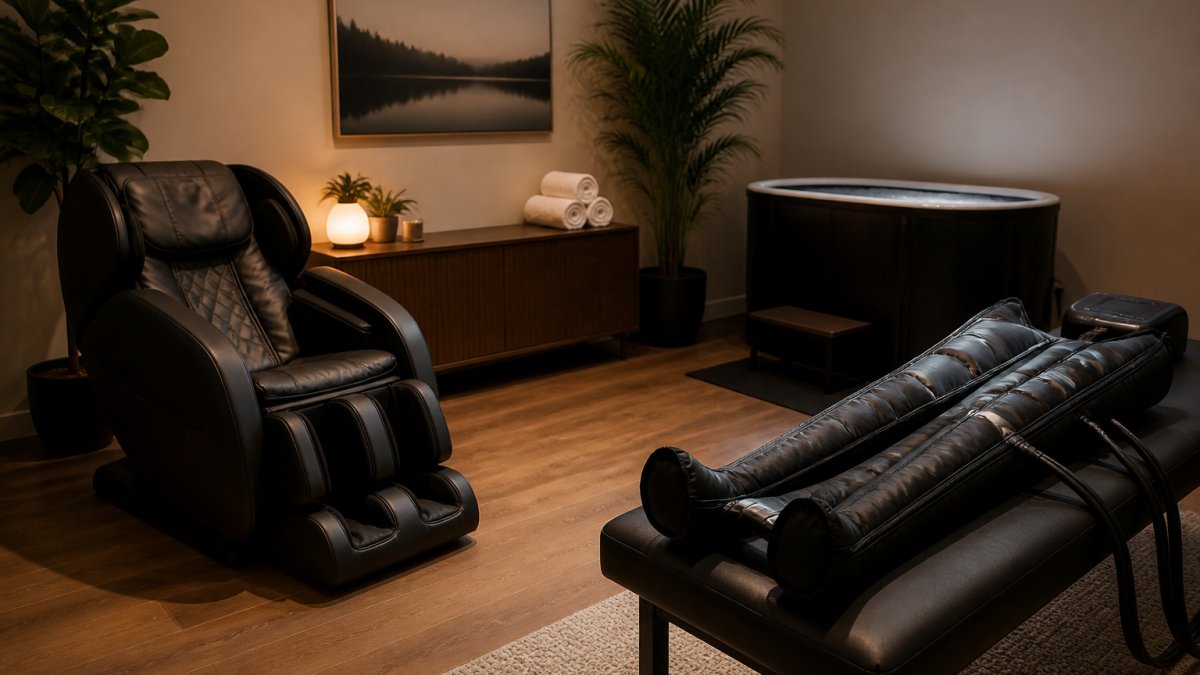
If you have the square footage, build it as its own room. If not, carve out a corner and treat it as a zone with its own lighting and flooring.
Most guides stop at the product list. The difference between a recovery room that works and one that becomes an expensive storage closet is the technical planning underneath it.
Room-Specific Technical Planning
Work through these requirements before you order equipment, because each one can force a layout change:
- Floor loading. A filled cold plunge tub is heavy. A 120-gallon tub plus water, chiller, and a bather can approach or exceed 1,000 lb concentrated on a small footprint. Confirm the live-load capacity of the floor with a structural professional, and never place a filled tub on a raised wood deck or upper floor without an engineer's sign-off.
- Ceiling height. A massage chair in zero-gravity recline needs roughly 6.5 to 7 ft of clear height plus room to recline; a sauna needs its own ceiling and clearance above for ventilation. Measure to the lowest obstruction, not the nominal ceiling.
- Power. Cold plunge chillers and infrared saunas draw continuous current and typically want dedicated circuits. Check the nameplate amperage on each unit, confirm available panel capacity, and plan GFCI protection for anything near water. A licensed electrician should confirm circuit and grounding requirements for wet locations.
- Drainage and water. Plunge tubs need a fill source and a way to drain and sanitize. Plan a floor drain or a hose route, and decide how you will treat water (filter, ozone, or chemical) before the tub arrives.
Recovery Equipment Comparisons and Decision Criteria
Choose recovery equipment by protocol fit first, footprint second, and total cost third. A tool you use daily beats a more impressive one you avoid.
Echelon Advanced Cold Chiller →
| Equipment | Best For | Space Needed | Protocol | Maintenance |
|---|---|---|---|---|
| Compression boots | Post-training circulation, leg fatigue | Small, storable | 20-30 min after sessions | Wipe down sleeves; replace liners periodically |
| Massage chair | Full-body relaxation, stress reduction | Medium, fixed | 15-30 min, daily | Upholstery care; service access for motors |
| Cold plunge tub | Post-training cold exposure | Medium, fixed | Short, controlled sessions | Filtration, sanitizer, chiller service |
| Infrared sauna | Heat-based relaxation | Medium to large, fixed | 20-30 min sessions | Heater inspection; ventilation and humidity control |
The Helios Massage Chair 8000 suits this room well: smart body scan, zero gravity recline, reflexology foot rollers, and full-body air compression, with minimal assembly required.
Flooring, Lighting, Ventilation, and Climate Control
Flooring, lighting, ventilation, and climate control decide whether a luxury gym feels luxurious in daily use. Rubber flooring protects the underlying surface and deadens sound. Interlocking tiles let you vary thickness: thicker under weights, thinner in the recovery zone.
Lighting should be layered. Bright, cool light over the strength zone; warm, dimmable light in recovery. Ventilation matters most around cardio and sauna equipment, and climate control keeps a recovery room usable year-round.
Setting a Realistic Home Gym Budget
Set the home gym budget by zone, not by wishlist. Allocate roughly half to strength and cardio, a quarter to flooring and infrastructure, and a quarter to recovery equipment, then adjust to your goals.
Recovery tools scale widely in price. The Echelon Advanced Cold Chiller is $899.99 and pairs with hard or inflatable tubs. Compression boots sit at $459.00 to $599.99.

Total Cost of Ownership and Operating Requirements
Purchase price is only part of the number. The gap most guides leave is what the room costs to own and run. Build a simple total-cost-of-ownership sheet with four columns: purchase, installation, consumables, and ongoing energy and maintenance.
- Installation and infrastructure. Dedicated circuits, GFCI protection, a floor drain, an exhaust fan, and a dehumidifier are real line items. Get an electrician's quote for panel capacity and circuit runs before you commit to a chiller or sauna.
- Water treatment and consumables. Plunge tubs need filters, sanitizer, and periodic water changes. Budget for filter replacements and test kits, and decide whether you will use ozone, UV, or chemical treatment.
- Energy use. Chillers and sauna heaters run in cycles and are the largest ongoing draw. Check the unit's rated wattage and estimate hours of use per week against your electricity rate; a continuously running chiller can rival a small appliance in annual cost.
- Maintenance and service. Massage chairs need motor and upholstery service; saunas need heater inspection; chillers need coil cleaning. Set aside a maintenance reserve rather than treating service as a surprise.
Measuring Outcomes and Personalizing the Setup
The budget should follow use, not aesthetics. Track which tools you actually touch for two weeks: log sessions, duration, and how you feel the next day. If compression boots get daily use and the sauna gets weekly use, shift the next dollar toward the tool with the higher adherence. A recovery setup is only luxurious if it is used, and the cheapest way to waste a budget is to buy for the room's look rather than your routine.
Safety, Accessibility, and Contraindications
Safety planning belongs in the design, not the manual. Keep clear paths, non-slip surfaces near water, and stable footing around every fixed machine.
Accessibility matters for every user group. Leave turning room for mobility aids, keep controls reachable, and avoid steps into wet areas.
A common mistake is treating recovery gear as risk-free because it feels passive. It is not.
Frequently Asked Questions
What should a luxury home gym recovery setup include?
A complete home gym recovery setup typically includes four categories: a cold plunge or chiller system, compression therapy, a massage chair or massage gun, and mobility tools like mats and foam rollers. Add a hydration station and climate control to make the room usable year-round. Prioritize one recovery modality you will actually use daily over four you use monthly. Logic Health's Echelon Advanced Cold Chiller ($899.99) and Airvida Cordless Leg Compressions ($459.00) are solid starting points for a compact recovery corner.
How much space do you need for a home gym and recovery setup?
A functional home gym needs roughly 100 to 200 square feet for a rack, bench, and cardio machine. A separate recovery room adds 60 to 120 square feet depending on equipment. A massage chair needs about 30 square feet with recline clearance, a cold plunge tub needs 15 to 25 square feet, and compression boots need only a chair and a power outlet. If space is tight, zone one larger room instead of building two: place recovery equipment along one wall and keep 3 feet of clear walkway around every piece.
Is a sauna or cold plunge worth adding to a home gym?
Both earn their place if you will use them three or more times per week. Cold plunge supports post-training recovery and mental alertness, while sauna supports relaxation and circulation. The practical question is operating cost and installation: chillers need ventilation and a dedicated outlet, and saunas need proper electrical work. Start with a chiller-and-tub kit like the FCP Premium XL 120 Gal Cold Plunge Tub Kit ($1,099.97), which includes the chiller, filter, and pump, then add a sauna in a later phase if recovery stays consistent.
How do you plan ventilation, flooring, and lighting for a home gym?
Flooring first: rubber or interlocking tiles protect the subfloor and reduce noise, and a waterproof tray under a cold plunge protects against spills. Ventilation matters most in recovery rooms, where humidity from tubs and heat from saunas builds up; an exhaust fan sized to the room volume keeps moisture under control. For lighting, use dimmable overhead fixtures plus task lighting near equipment, and keep glare off screens and mirrors. Climate control keeps the room usable in summer and winter, which directly affects how often you train and recover there.
How can you create a luxury home gym on a budget?
Build in phases. Phase one covers flooring, lighting, and strength basics. Phase two adds one recovery modality, such as compression boots at $459.00 or a cold plunge kit at $1,099.97. Phase three adds the big-ticket items like a massage chair. Buy equipment that serves two purposes, keep the layout simple, and spend on the items you touch daily. Logic Health offers free shipping on orders over $200 and a 30-day return policy, which lowers the risk of trying a recovery tool before committing to a full build.
Will a massage chair help chronic lower back pain?
A massage chair can ease muscle tension and support relaxation, which many people with desk-related back tightness find useful. It is not a treatment for a diagnosed condition, so check with your doctor before relying on one for chronic pain. Look for features that matter for back comfort: body scan technology, zero gravity recline to reduce spinal pressure, and adjustable intensity. The Helios Massage Chair 8000 ($9,999.00) includes all three. Use it as one part of a routine that includes movement and professional care, not as a replacement.
Building a recovery-focused gym is a design problem before it is a shopping problem. Logic Health supplies the equipment that makes the plan real: compression boots, cold plunge systems, and massage chairs backed by free shipping on orders over $200, a 30-day return policy, and 24/7 customer support. Start with the room, then let us help you fill it.